- Engineering & Construction
- Environment
- Telecommunications
- Renewable energies
- Ventures
- Real estate
Respect. (from the lat. respectu) n. 1. respect; 2. consideration; high regard; 3. deference; compliance; veneration; 4. honour; worship; 5. relation; refererence...
We believe that everyone should be respected for their work, for their attitudes, opinions and options.
Rigor. (from the lat. rigore) n. 1. harshness; strength; 2.fig., severity; punctuality; accuracy.
There is no "more or less levelled", "more or less upright”, "more or less clean" or "more or less safe", but rather “levelled”, "upright”, "clean” and “safe". The rigour is reflected in our procedures, in time and in the rules to follow. In the light of moral and principles, being severe means being rigorous.
Passion. (from the lat. passione) n. 1. intense and usually violent feeling (affection, joy, hate, etc.) which hinders the exercise of impartial logic; 2. derived from a feeling; 3. great predilection; 4. partiality; 5. great grief; immense suffering...
Under the sign of passion – a text of the Portuguese poet Regina Guimarães – is our icon. Passion is to reveal great enthusiasm for something, favourable encouragement or opposite to something.
It is the sensibility transmitted by an architect or engineer through work.
Passion is the dedication to a project. Passion is a state of warm soul.
Loyalty. (from the lat. legalitate) n. the quality of being loyal; fidelity; sincerity.
Respect for the principles and rules that guide the honour and probity. Faithfulness to commitments and agreements undertaken, staunch character.
To remain loyal to the business partners because we depend on them and they depend on us.
Being trustworthy for being loyal.
Solidarity. (from the lat. solidare) n. 1. the quality of being solidary; 2. reciprocal responsibility among the members of a group, namely social, professional, etc.; 3. sense of sharing another’s suffering.
Being solidary is being a friend, offering our hand with genuine generosity and bringing joy and human warmth to those who, somehow, are marginalized. Being solidary is being more human. A solidary company is recognized as a fair and non-selfish company. A solidary company is a preferred choice in business. It is a more competitive company. Volunteering is a vehicle to solidarity. It is modern, fair, cultured, friend, it is a noble gesture of moral elevation.
Courage. (from the lat. coraticum) n. 1. bravery facing danger; intrepidity; to have audacity; 2. moral force before a suffering or setback; 3. [fig.] to input energy when performing a difficult task; perseverance...
Courage is essential in our life. Courage to face less pleasant situations when complex issues come up, not expecting random resolutions.
It is a value that we must highlight as opposed to the fearful, cowardly and laziness.
The courage to react to criticism not with an attitude of demotivation or sadness, but rather to search for the means and the action to overcome its own reason. This kind of courage, which is also an intellectual courage, is highly recommended.
Ambition. (from the lat. ambitione) n. 1. vehement desire of wealth, honours or glories; 2. expectation about the future; aspiration; 3. lust; greed…
Vehement desire to achieve a particular goal. Ambition not to resign ourselves. Ambition to take the best potential from ourselves. Ambition to deserve ourselves. Ambition to be athletes in our top-level competitive jobs. Ambition to beat our brands. Ambition to get the best deals with the maximum value, due to the high levels of proficiency and efficiency.
Esthetics. ESTHETICS (from the Greek aisthetiké, "sensitive") n.f. 1. Philosophy branch of philosophy that studies the beauty and nature of artistic phenomena; 2. author's own style, time, etc.; 3. harmony of shapes and colors, beauty; 4. set of techniques and treatments that aim to beautify the body.
We decided to build the company's economic foundations under a cultured, cosmopolitan and cool image. Because it is a charming state of being. Good taste because we are sustainable and we respect the planet. Good taste because we are sensitive. Good taste just because.
Responsibility. (from the lat respondere) n. the trait of being answerable to someone for something or being responsible for one's conduct; a form of trustworthiness.
We must be certain that, before a choice, we chose what is best for both of us and not just the best for each one. Each employee is responsible for his negotiated activity and co-responsible if the co-worker does not fulfil his own task, thus preventing the common goal. A team is a set of individuals - is a whole. In the business game, as in social or family contexts, everyone must comply with their own relative position and we shall not permit that one of ours fails to be in our team.
Expresso
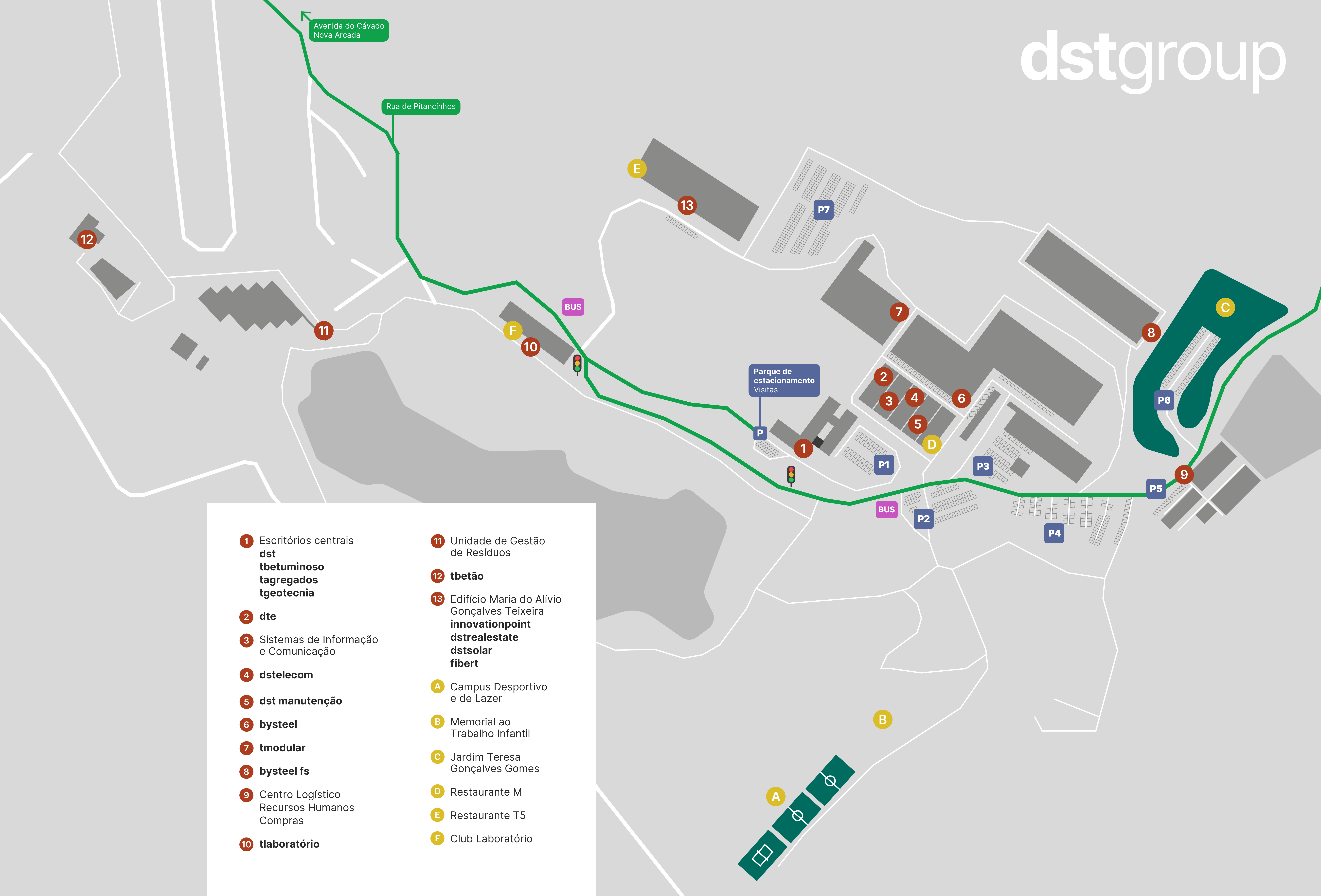
Factories and works of art advance side by side at DST’s premises. The company believes that culture brings business.
At DST’s headquarters in Braga, works of art are everywhere: outside there are installations and works by artists such as Vhils, Rui Chafes, Manuela Pimentel, Ângela Ferreira, Pedro Cabrita Reis and José Pedro Croft; inside the offices and canteens there are paintings and sculptures; and there are factories and buildings — some already built, others under construction — designed by major names in architecture such as the Portuguese architects Siza Vieira and Souto de Moura, and the British architect Norman Foster, all Pritzker Prize winners.
There is also a chapel, a restaurant, a nightclub, a gym, a school, a space for cultural events such as theatre or book launches, a health centre, a laundry, a hair salon, a picnic area and a community garden. There are even donkeys there, including “Hortelã”, grazing peacefully.
And there is ambition: to place that space — the DST Campus — on the cultural map as “an open-air museum”, so that Braga has another reason to be visited: “as well as Bom Jesus, the DST effect.”
The DST Campus in Braga is being thought of as an open-air museum available to anyone who wishes to visit it.
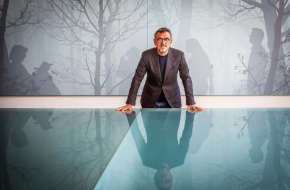
José Teixeira is the ‘architect’ of this project, which aims to become a reference point, a perfect marriage between culture and the economy. The CEO of DST, the business group that has its roots in construction, recalls cases in regions of other countries that rose to international prominence — and generated wealth as a result — thanks to their investment in culture and architecture. The most striking example, because it is close to Portugal, is Bilbao in Spain. There, however, there was not already a city established as a cultural and tourist destination such as Braga, also known as the “Portuguese Rome” or the “city of archbishops” because of its many churches, of which the Sanctuary of Bom Jesus is the most important example. Bilbao was a declining city, but from 1997 it became part of the global museum circuit with the iconic Guggenheim Museum, designed by the North American architect Frank Gehry. Braga will also soon have a new museum in its historic centre: Muzeu — the DST Museum of Thought and Contemporary Art, created by the company and due to open to the public on 25 April.
“This may sound a little arrogant, but I usually speak of a ‘DST effect’, inspired by the Bilbao effect, where it was the power of culture that transformed that entire region”, states the entrepreneur. “I want people to say, ‘I have to go to Braga.’ And why do I have to go to Braga? Because of Bom Jesus and DST.”
‘FURIOUS’ CULTURE...
The entrepreneur does not hide his interest in opening the DST Campus to the public — which can already be visited. However, he rejects the idea of charging admission. “Charging no, absolutely not. But there will be an organised visitor programme. We receive visits here every day and, in some way, we need to structure them, with a defined route, and we also have to consider safety issues in the factories.”
One of the projects that has generated the most anticipation is called Living Lab and was announced in 2022. Designed by Norman Foster, it is currently under development, with five functional areas being created through modular construction — referred to at DST as industrialized construction. This involves producing parts of houses in factories and then assembling them on-site, freeing cities from endless construction sites and reducing noise, air, and visual pollution, while also shortening construction times.
The site will include an apartment tower, a hotel, student and senior residences, and a healthcare centre, forming an example of what a city free from ongoing construction could look like. The aim is for everything to be completed by September.
The factory producing components for industrialized construction is being finalized by the architect Siza Vieira for the Zethaus company, although it is already operational. Right next door is another factory, designed by Souto Moura, that of Lyrical Design Windows, specializing in minimalist window frames.
A crèche is also under construction and is expected to open later this year. This has been designed by the architect Carvalho Araújo, who also oversaw the restoration of the building that now houses the Muzeu.
José Teixeira was not present during Expresso’s brief visit to the DST Campus — “with me explaining, it would have taken four hours”, he jokes — but the space clearly reflects the vision of this entrepreneur, who has made culture a key driver of his group’s growth. Industrial investments have progressed considerably in parallel with cultural initiatives, with the group notable for its support of theatre and literature.
Ensuring that culture is accessible to all is another cornerstone of DST’s policies. That is why employees are encouraged to submit poems for selection and public reading. There is also the “Furious Reading Thursdays”, an initiative that invites them to share something they have read.
...DURING WORKING HOURS
“We conduct all our cultural activities within the group during working hours. This is an investment. It may be this very activity that leads to the emergence of new business opportunities. There is a creative energy here, what I would call an imagination spread across a large number of employees. I often say that the economy was built on experience, knowledge and creativity. Today, it is built on imagination, on the capacity for madness that we have embedded within the group”, he explains.
In recent years, José Teixeira has diversified the group’s business areas, always guided by the question: ‘Why not me?’
Innovation, identified as a core pillar of the company, stems from this mindset. Productivity, where “there is still a long way to go”, is another focus. “I do not want a company that is just obedient. I want a company that says ‘no’. There must be room for that kind of freedom. And from there, we will truly create conditions that enable the economy to generate more value, with products that can hold their own in competitive markets,” says José Teixeira. The entrepreneur also believes, based on studies, that “companies with organized unions are more productive.” For this reason, he is interested in moving more closely to the German management model, in which employees are elected to company boards.
ORIGINS IN 1 MAY
The origins of the DST Group date back to 1946, founded by Domingos Silva Teixeira, José’s father, whose initials give the group its name. The company began with the extraction of aggregates and, in the 1970s, supplied materials for the construction of the 1º de Maio Stadium. In recent years, José Teixeira has continued to diversify the group’s business areas, always driven by the question: ‘Why not me?’
It was this mindset, he explains, that led him into train manufacturing in Portugal. “There was a tender, with a base value of a little over one billion euros, for the supply of trains to CP. And I asked myself: why not me? And suddenly, I partnered with Alstom in a consortium. DST is not a train manufacturer, but can produce parts and carriage components, so it is then able to move into a new business area.”
Alongside imagination, he highlights the importance of curiosity: “Curiosity should be a compulsory subject at school. Let’s be curious.”