- Engineering & Construction
- Environment
- Telecommunications
- Renewable energies
- Ventures
- Real estate
Respect. (from the lat. respectu) n. 1. respect; 2. consideration; high regard; 3. deference; compliance; veneration; 4. honour; worship; 5. relation; refererence...
We believe that everyone should be respected for their work, for their attitudes, opinions and options.
Rigor. (from the lat. rigore) n. 1. harshness; strength; 2.fig., severity; punctuality; accuracy.
There is no "more or less levelled", "more or less upright”, "more or less clean" or "more or less safe", but rather “levelled”, "upright”, "clean” and “safe". The rigour is reflected in our procedures, in time and in the rules to follow. In the light of moral and principles, being severe means being rigorous.
Passion. (from the lat. passione) n. 1. intense and usually violent feeling (affection, joy, hate, etc.) which hinders the exercise of impartial logic; 2. derived from a feeling; 3. great predilection; 4. partiality; 5. great grief; immense suffering...
Under the sign of passion – a text of the Portuguese poet Regina Guimarães – is our icon. Passion is to reveal great enthusiasm for something, favourable encouragement or opposite to something.
It is the sensibility transmitted by an architect or engineer through work.
Passion is the dedication to a project. Passion is a state of warm soul.
Loyalty. (from the lat. legalitate) n. the quality of being loyal; fidelity; sincerity.
Respect for the principles and rules that guide the honour and probity. Faithfulness to commitments and agreements undertaken, staunch character.
To remain loyal to the business partners because we depend on them and they depend on us.
Being trustworthy for being loyal.
Solidarity. (from the lat. solidare) n. 1. the quality of being solidary; 2. reciprocal responsibility among the members of a group, namely social, professional, etc.; 3. sense of sharing another’s suffering.
Being solidary is being a friend, offering our hand with genuine generosity and bringing joy and human warmth to those who, somehow, are marginalized. Being solidary is being more human. A solidary company is recognized as a fair and non-selfish company. A solidary company is a preferred choice in business. It is a more competitive company. Volunteering is a vehicle to solidarity. It is modern, fair, cultured, friend, it is a noble gesture of moral elevation.
Courage. (from the lat. coraticum) n. 1. bravery facing danger; intrepidity; to have audacity; 2. moral force before a suffering or setback; 3. [fig.] to input energy when performing a difficult task; perseverance...
Courage is essential in our life. Courage to face less pleasant situations when complex issues come up, not expecting random resolutions.
It is a value that we must highlight as opposed to the fearful, cowardly and laziness.
The courage to react to criticism not with an attitude of demotivation or sadness, but rather to search for the means and the action to overcome its own reason. This kind of courage, which is also an intellectual courage, is highly recommended.
Ambition. (from the lat. ambitione) n. 1. vehement desire of wealth, honours or glories; 2. expectation about the future; aspiration; 3. lust; greed…
Vehement desire to achieve a particular goal. Ambition not to resign ourselves. Ambition to take the best potential from ourselves. Ambition to deserve ourselves. Ambition to be athletes in our top-level competitive jobs. Ambition to beat our brands. Ambition to get the best deals with the maximum value, due to the high levels of proficiency and efficiency.
Esthetics. ESTHETICS (from the Greek aisthetiké, "sensitive") n.f. 1. Philosophy branch of philosophy that studies the beauty and nature of artistic phenomena; 2. author's own style, time, etc.; 3. harmony of shapes and colors, beauty; 4. set of techniques and treatments that aim to beautify the body.
We decided to build the company's economic foundations under a cultured, cosmopolitan and cool image. Because it is a charming state of being. Good taste because we are sustainable and we respect the planet. Good taste because we are sensitive. Good taste just because.
Responsibility. (from the lat respondere) n. the trait of being answerable to someone for something or being responsible for one's conduct; a form of trustworthiness.
We must be certain that, before a choice, we chose what is best for both of us and not just the best for each one. Each employee is responsible for his negotiated activity and co-responsible if the co-worker does not fulfil his own task, thus preventing the common goal. A team is a set of individuals - is a whole. In the business game, as in social or family contexts, everyone must comply with their own relative position and we shall not permit that one of ours fails to be in our team.
Diário de Notícias
The artists worked with female inmates at Tires Prison Establishment and young people at Leiria Prison. The Vatican’s “Doors of Hope - Jubilee 2025” initiative will now continue in Italy.
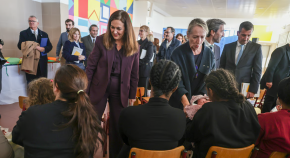
What sets the “Doors that Poetry Opened” prison art project apart from other artistic initiatives involving inmates is the “professionalism” with which it was developed. That was how it was described by the Minister for Justice, Rita Alarcão Júdice, in statements made to DN at the presentation of the project on Friday, 28 November, at the Tires Prison Establishment.
The professionalism she mentioned was due to the patronage of the dst group, led by its CEO José Teixeira, and the involvement of its ZET gallery, which selected the artists who worked with the inmates at Leiria Prison Establishment and the House for Mothers in Tires.
It was ZET’s director-general, Helena Mendes Pereira, who invited the artist Ilídio Candja Candja to work with around 15 young adult inmates in Leiria and Fernanda Fragateiro to work on a project with the mothers at the Tires prison.
Along with the young people, Ilídio Candja Candja created a set of drawings that were then developed into a mural.
As regards to the intervention made at the House for Mothers, Helena Mendes Pereira underlined that, “I never had any doubts that Fernanda Fragateiro was the one to tackle this difficult, complex and entangled space. She works a lot with words and colours, as well as having suitable human qualities”.
It was the gallerist who named the project “The Doors that Poetry Opened”, which forms Portugal’s participation in the initiative “The Doors of Hope – Jubilee 2025”, promoted by the Holy See’s Dicastery for Culture and Education, led by Cardinal Tolentino de Mendonça, who was also present at the Prison in Tires this Friday and who thanked the Portuguese government for its openness to hosting the project.
A cooperation protocol was established between the Directorate-General for Reintegration and Prison Services, the Jornada Foundation and the ZET gallery to realise this project. The Jornada Foundation was created in 2019 to prepare for the World Youth Day in Lisbon in 2023, which brought Pope Francis to Portugal. Its mission now is to “perpetuate the legacy left by Pope Francis to young people”.
Tolentino de Mendonça recalled that “in the Jubilee Bull the Holy Father prioritised prisons”, and that “the reality of prisons undoubtedly needs this support”. The cardinal emphasised that “as the Holy See we believe very much in this project, which began in Portugal and which will move on to Italy in December”. In Italy there will be 12 projects.
Tolentino de Mendonça told DN that the “enthusiasm in Portugal” surrounding the initiative will make it possible to “extend it over time” and that it should be repeated in the coming years.
For the prefect of the Holy See’s Dicastery for Culture and Education, “art leads the way, opens up new paths, new leads, searching out possibilities for social communities. This has been a participatory project, and an artistic project that tells us a lot.”
Fernanda Fragateiro worked on Mondays and Fridays for around a month and a half with between 10-12 inmates, with the idea of intervening in the space, as she had done in a secondary school previously. “This was the same strategy as Camões. Using very abstract art that makes the space expand, making it brighter, making it strange”, the artist told DN, pointing to a yellow square in one corner of a wall in the House for Mothers’ dining room, and another, which was blue, on the opposite wall.
Phrases could also be seen on the walls. Fernanda Fragateiro explained that a list of 300 words was drawn up and from these ten were chosen. A poem was selected for each of them, in cooperation with Luiza Teixeira de Freitas. The phrases that can be seen in the various areas of the House for Mothers came from these poems.
The inmates also drew pictures on cardboard inspired by the Unreadable Books of the Italian artist Bruno Munari, creating coloured geometric patterns for cushions. The cardboard became a mural displayed on one of the cafeteria walls.
As part of this work with Fernanda Fragateiro, the inmates wanted to paint the cell doors, which were grey, on which they also inscribed a word. The artist chose the colours. With the leftover paint they also painted the insides of the cell, and in most of these cells, a baby cot can be seen next to a single bed. “We wanted to create a better space, so it would not be so burdensome when serving time and also for the children,” said one of the inmates to DN, who has a fifteen-month-old child with her in that house. Her door is blue and has the word “beach” written on it. Another woman has a lilac door and the word “saudade”. She is there with twin 11-month-old girls, and will be released next year. The wing with the doors painted in gradients also portrayed the words “pearl”, “harmony”, “shine”, “dawn”, “utopia”, “embrace” and “soon”.
Fernanda Fragateiro stated that this project has resulted in “two important things: firstly, what the space has gained, which is something that will remain. The other thing is more intangible - the unity of the inmates pushing the project forward, the way they were seen, the respect between everyone.”