- Engineering & Construction
- Environment
- Telecommunications
- Renewable energies
- Ventures
- Real estate
Respect. (from the lat. respectu) n. 1. respect; 2. consideration; high regard; 3. deference; compliance; veneration; 4. honour; worship; 5. relation; refererence...
We believe that everyone should be respected for their work, for their attitudes, opinions and options.
Rigor. (from the lat. rigore) n. 1. harshness; strength; 2.fig., severity; punctuality; accuracy.
There is no "more or less levelled", "more or less upright”, "more or less clean" or "more or less safe", but rather “levelled”, "upright”, "clean” and “safe". The rigour is reflected in our procedures, in time and in the rules to follow. In the light of moral and principles, being severe means being rigorous.
Passion. (from the lat. passione) n. 1. intense and usually violent feeling (affection, joy, hate, etc.) which hinders the exercise of impartial logic; 2. derived from a feeling; 3. great predilection; 4. partiality; 5. great grief; immense suffering...
Under the sign of passion – a text of the Portuguese poet Regina Guimarães – is our icon. Passion is to reveal great enthusiasm for something, favourable encouragement or opposite to something.
It is the sensibility transmitted by an architect or engineer through work.
Passion is the dedication to a project. Passion is a state of warm soul.
Loyalty. (from the lat. legalitate) n. the quality of being loyal; fidelity; sincerity.
Respect for the principles and rules that guide the honour and probity. Faithfulness to commitments and agreements undertaken, staunch character.
To remain loyal to the business partners because we depend on them and they depend on us.
Being trustworthy for being loyal.
Solidarity. (from the lat. solidare) n. 1. the quality of being solidary; 2. reciprocal responsibility among the members of a group, namely social, professional, etc.; 3. sense of sharing another’s suffering.
Being solidary is being a friend, offering our hand with genuine generosity and bringing joy and human warmth to those who, somehow, are marginalized. Being solidary is being more human. A solidary company is recognized as a fair and non-selfish company. A solidary company is a preferred choice in business. It is a more competitive company. Volunteering is a vehicle to solidarity. It is modern, fair, cultured, friend, it is a noble gesture of moral elevation.
Courage. (from the lat. coraticum) n. 1. bravery facing danger; intrepidity; to have audacity; 2. moral force before a suffering or setback; 3. [fig.] to input energy when performing a difficult task; perseverance...
Courage is essential in our life. Courage to face less pleasant situations when complex issues come up, not expecting random resolutions.
It is a value that we must highlight as opposed to the fearful, cowardly and laziness.
The courage to react to criticism not with an attitude of demotivation or sadness, but rather to search for the means and the action to overcome its own reason. This kind of courage, which is also an intellectual courage, is highly recommended.
Ambition. (from the lat. ambitione) n. 1. vehement desire of wealth, honours or glories; 2. expectation about the future; aspiration; 3. lust; greed…
Vehement desire to achieve a particular goal. Ambition not to resign ourselves. Ambition to take the best potential from ourselves. Ambition to deserve ourselves. Ambition to be athletes in our top-level competitive jobs. Ambition to beat our brands. Ambition to get the best deals with the maximum value, due to the high levels of proficiency and efficiency.
Esthetics. ESTHETICS (from the Greek aisthetiké, "sensitive") n.f. 1. Philosophy branch of philosophy that studies the beauty and nature of artistic phenomena; 2. author's own style, time, etc.; 3. harmony of shapes and colors, beauty; 4. set of techniques and treatments that aim to beautify the body.
We decided to build the company's economic foundations under a cultured, cosmopolitan and cool image. Because it is a charming state of being. Good taste because we are sustainable and we respect the planet. Good taste because we are sensitive. Good taste just because.
Responsibility. (from the lat respondere) n. the trait of being answerable to someone for something or being responsible for one's conduct; a form of trustworthiness.
We must be certain that, before a choice, we chose what is best for both of us and not just the best for each one. Each employee is responsible for his negotiated activity and co-responsible if the co-worker does not fulfil his own task, thus preventing the common goal. A team is a set of individuals - is a whole. In the business game, as in social or family contexts, everyone must comply with their own relative position and we shall not permit that one of ours fails to be in our team.
Expresso
If it were a museum, it would be the one celebrating the worker. Pintancinhos Industrial Park in Braga, the dstgroup’s vast industrial complex, belonging to one of Portugal’s largest business groups, coexists, both indoors and out, with major works by Portuguese and international contemporary artists. Among the offices and factories of the dozens of companies that make up the DST group – one designed by Siza Vieira, another by Souto de Moura – reside works by Ângela Ferreira, Fernanda Fragateiro, Pedro Cabrita Reis, José Pedro Croft, Vhils, and others. And because there are not two Pritzkers without a third, the Living Lab, a microcity designed by Norman Foster, is now being built on the DST campus. These 30 public artworks in the public space join thousands more woven into daily work routines. The office of the CEO, José Teixeira, fits in with this pattern. It is where he welcomes O Expresso for a chat about the importance of “the good, the beautiful and the true,” moving beyond the collective and the need to engage in politics, themes that lead to the latest ambition of the businessperson, engineer and collector, namely, to open Braga’s first contemporary art museum.
José Teixeira began working at the age of 7, as a bricklayer’s assistant in his parents’ small company. Today he leads the DST group, a Braga powerhouse in engineering, construction, the environment, renewable energies, telecommunications and more, employing around 3000 people. Through the company’s services to the Braga Theatre Company (of which DST is now the exclusive patron), he began to collect serigraphs and lithographs from set designers such as Alberto Péssimo, forming the foundation of a 40-year collection now totalling 1500 works by 240 authors.
José Teixeira believes that “without the utility of the useless – the writers, the poets, the thinkers – the world breaks down, left without mechanics.” Out of this belief came the “DST School,” a philosophy that aims to provide humanistic and artistic training for all its employees. The Muzeu – Thought and Contemporary Art DST represents the latest and most ambitious extension of the company’s mission to “broaden the spirit” with extended opening hours, “to respect those who live and work in the area.” José Teixeira shared with Expresso that the project arose from the intention to give back to the city where Domingos da Silva Teixeira was born. The parent company will invest 40 million euros in the museum, between the building and the art collection. “If, in 50 years’ time, they ask ’who were these guys?’, I want them to think that we were the ones who believed in the importance of the arts, culture, philosophy and the humanities for economic development.”
INFLUENCING VOTERS
Helena Mendes Pereira believes that the museum will be “DST’s public voice” and one that is not intended to be neutral. The inaugural exhibition, “Let’s Be Realistic, Demand the Impossible (Sejamos Realistas, Exijamos o Impossível),” a reference to the student protests of May 1968, will showcase over 100 works by 96 artists, which explore the themes of memory, power, identity, work, resistance and freedom. These include names as varied as Pablo Picasso, Nan Goldin, Richard Long, Candida Hõfer, André Butzer, Sue Webster & Tim Noble, Caio Reisewitz, Jason Martin, Paula Rego, Helena Almeida, Pedro Cabrita Reis, Julião Sarmento, Alex Katz, Ana Vidigal, Angela Ferreira, Annie Leibovitz, Artur Lescher, Axel Hútte, Délio Jasse, Eduardo Batarda, Fernão Cruz, Francesco Clemente, Franz West, Gary Webb, Isabel Muñoz, Jean-Baptiste Huynh, João Penalva, José Bechara, Julian Opie, Manuel Rosa, Muntean & Rosenblum, Pedro Calapez, Peter Zimmermann, Rui Sanches and Susy Gómez. The painter and sculptor Anselm Kiefer will have a room dedicated to his works at the Muzeu, akin to Richard Serra in Bilbao or Mark Rothko in London. Three of the pieces already belong to the DST collection. Kiefer’s studio worked with Helena Mendes Pereira to select the rest that will make up what will be the first space dedicated exclusively to the artist, which will include a visit to Braga for the installation. The curator explained that this permanent exhibition “is a kind of mausoleum reflecting our concerns. And Kiefer is ideal because his work is challenging, not easily digestible, even perturbing and grotesque, which is precisely what interests us.”
The Muzeu has the stated mission of “influencing voters’ choices for a good life for all.” José Teixeira believes that art is not neutral; “it holds transformative, disruptive power. Everything can become something else through art and we want to provoke questioning,” he told Expresso. For him, art ignites unity and the exercise of politics, which he considers to be far removed from its Greek origin as a space for communal creation. “Art is a treatise on imagination, and understanding others depends on our imaginative capacity.”
FROM EXHIBITION TO REFLECTION
If the company resembles a museum, the Muzeu evokes a factory of the future. Over four floors, vast exhibition halls echo factory floors. The details of unexpected pairings of materials such as marble and sheet metal marry the sublime within art to the commonplace of industry. The building and furniture were designed by José Carvalho Araújo, whose studio has a long-standing relationship with the city. The Braga architect believes that “architecture itself is the first work of art, the one that permanently endures,” which justifies the space’s sparse language as a harmonising canvas for passing works. Another value of the space is its availability, which Carvalho Araújo links to the patron’s personality and which “makes this museum a creative museum, collaborative and city-facing rather than static or crystallised.”
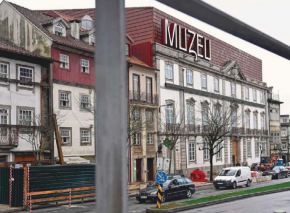
The Muzeu revives the Vilhena Coutinho Palace, a former courthouse with a cultural past closely linked to the Braga Theatre Company, between Praça do Município, a few metres from Braga City Hall, and Praça Conde de Agrolongo. According to the architect, the Muzeu will function as a third square, “a connecting space where culture happens.” At the future entrance is the city's longest stretch of wall, started in the 14th century, and a medieval well. The main façade features a permanent bronze-painted intervention by José Pedro Croft on the openings and doors moulded from the wooden originals designed by Carlos Amarante. The bronze of the doors and the tile hues reference Florence’s Santa Maria del Fiore Cathedral, evoking the Medici’s cultural patronage, once more drawing a comparison between the building and the personality of the engineer-collector.
The 3000 square metres of exhibition space unfold around a large concrete, seemingly infinite staircase, rising skyward to the fifth floor. Here there is a 150-seat auditorium which has been baptised the Assembleia. “It’s the element growing above the building and makes the Muzeu a reflexive space and not merely an exhibition space,” concludes José Teixeira. The large windows on the top floor offer a view of the city of Braga.
The packed programme for the Muzeu’s inaugural cycle, entitled “Opening April” (Abrir Abril), includes partnerships with various organisations and artistic entities, including a jazz cycle with the Hot Club of Portugal, a series of talks celebrating the 50th anniversary of the Portuguese Constitution, in collaboration with José Pacheco Pereira’s Ephemera Library and Archive, a Listening Club organised by the Porto-based Matéria Prima, philosophy workshops for children and a dance and performance cycle.