- Engineering & Construction
- Environment
- Telecommunications
- Renewable energies
- Ventures
- Real estate
Respect. (from the lat. respectu) n. 1. respect; 2. consideration; high regard; 3. deference; compliance; veneration; 4. honour; worship; 5. relation; refererence...
We believe that everyone should be respected for their work, for their attitudes, opinions and options.
Rigor. (from the lat. rigore) n. 1. harshness; strength; 2.fig., severity; punctuality; accuracy.
There is no "more or less levelled", "more or less upright”, "more or less clean" or "more or less safe", but rather “levelled”, "upright”, "clean” and “safe". The rigour is reflected in our procedures, in time and in the rules to follow. In the light of moral and principles, being severe means being rigorous.
Passion. (from the lat. passione) n. 1. intense and usually violent feeling (affection, joy, hate, etc.) which hinders the exercise of impartial logic; 2. derived from a feeling; 3. great predilection; 4. partiality; 5. great grief; immense suffering...
Under the sign of passion – a text of the Portuguese poet Regina Guimarães – is our icon. Passion is to reveal great enthusiasm for something, favourable encouragement or opposite to something.
It is the sensibility transmitted by an architect or engineer through work.
Passion is the dedication to a project. Passion is a state of warm soul.
Loyalty. (from the lat. legalitate) n. the quality of being loyal; fidelity; sincerity.
Respect for the principles and rules that guide the honour and probity. Faithfulness to commitments and agreements undertaken, staunch character.
To remain loyal to the business partners because we depend on them and they depend on us.
Being trustworthy for being loyal.
Solidarity. (from the lat. solidare) n. 1. the quality of being solidary; 2. reciprocal responsibility among the members of a group, namely social, professional, etc.; 3. sense of sharing another’s suffering.
Being solidary is being a friend, offering our hand with genuine generosity and bringing joy and human warmth to those who, somehow, are marginalized. Being solidary is being more human. A solidary company is recognized as a fair and non-selfish company. A solidary company is a preferred choice in business. It is a more competitive company. Volunteering is a vehicle to solidarity. It is modern, fair, cultured, friend, it is a noble gesture of moral elevation.
Courage. (from the lat. coraticum) n. 1. bravery facing danger; intrepidity; to have audacity; 2. moral force before a suffering or setback; 3. [fig.] to input energy when performing a difficult task; perseverance...
Courage is essential in our life. Courage to face less pleasant situations when complex issues come up, not expecting random resolutions.
It is a value that we must highlight as opposed to the fearful, cowardly and laziness.
The courage to react to criticism not with an attitude of demotivation or sadness, but rather to search for the means and the action to overcome its own reason. This kind of courage, which is also an intellectual courage, is highly recommended.
Ambition. (from the lat. ambitione) n. 1. vehement desire of wealth, honours or glories; 2. expectation about the future; aspiration; 3. lust; greed…
Vehement desire to achieve a particular goal. Ambition not to resign ourselves. Ambition to take the best potential from ourselves. Ambition to deserve ourselves. Ambition to be athletes in our top-level competitive jobs. Ambition to beat our brands. Ambition to get the best deals with the maximum value, due to the high levels of proficiency and efficiency.
Esthetics. ESTHETICS (from the Greek aisthetiké, "sensitive") n.f. 1. Philosophy branch of philosophy that studies the beauty and nature of artistic phenomena; 2. author's own style, time, etc.; 3. harmony of shapes and colors, beauty; 4. set of techniques and treatments that aim to beautify the body.
We decided to build the company's economic foundations under a cultured, cosmopolitan and cool image. Because it is a charming state of being. Good taste because we are sustainable and we respect the planet. Good taste because we are sensitive. Good taste just because.
Responsibility. (from the lat respondere) n. the trait of being answerable to someone for something or being responsible for one's conduct; a form of trustworthiness.
We must be certain that, before a choice, we chose what is best for both of us and not just the best for each one. Each employee is responsible for his negotiated activity and co-responsible if the co-worker does not fulfil his own task, thus preventing the common goal. A team is a set of individuals - is a whole. In the business game, as in social or family contexts, everyone must comply with their own relative position and we shall not permit that one of ours fails to be in our team.
País positivo
In an era marked by the rapid pace of technological transformation, pressure on cities, and the urgent need to rethink development models, there are companies that choose not only to keep pace with change but to actively participate in shaping the future.
The dstgroup is one such example.
Founded in Braga and deeply rooted in engineering and construction, the group has carved out a unique path in the Portuguese business landscape over the past decades. More than just growing in size, dstgroup has forged a distinct identity: an ecosystem where industry, innovation, architecture, art, culture, and humanistic thought coexist as integral parts of the same strategic vision.
Today, the group operates in areas as diverse as engineering and construction, the environment, energy, telecommunications, industry, and technology, while maintaining a common thread across all of them: the creation of sustainable value with a real impact on society and the local community.
But what truly sets dstgroup’s journey apart is perhaps the way it understands the role of the contemporary company.
In an economic context often dominated by financial metrics and immediate results, the group has championed a broader vision of the economy—a vision where knowledge, culture, critical thinking, and social responsibility are not seen as ancillary elements, but as essential tools for transformation.
This vision has been repeatedly championed by José Teixeira, president of dstgroup, who asserts that economic development cannot exist in isolation from education, culture, and the cultivation of thought. For, more than simply producing buildings or infrastructure, what matters is contributing to the creation of cities that are more balanced, more cultured, and more humane.
It is precisely this vision that is taking shape today in a particularly evident way at the dst campus in Braga.
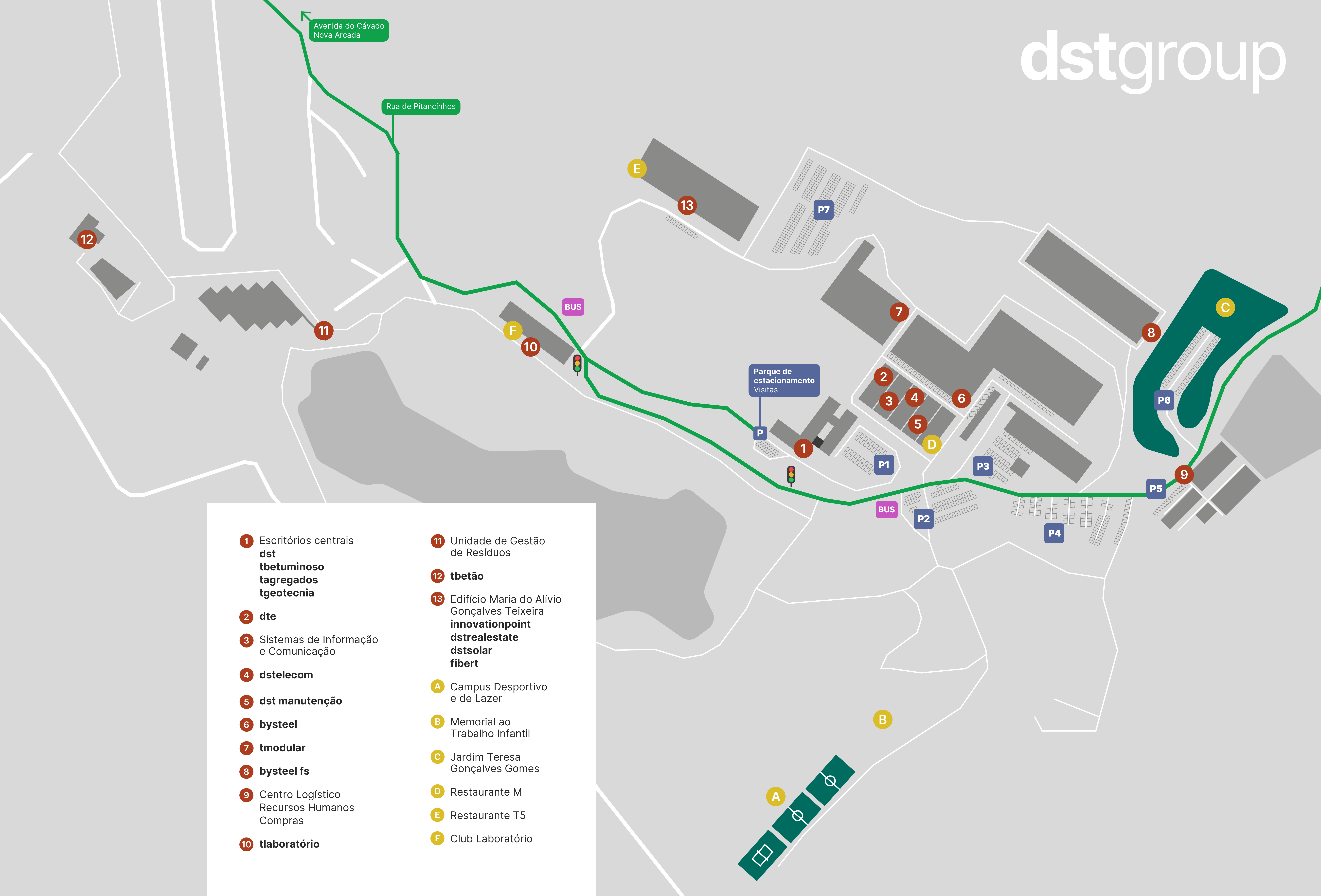
More than just a business center, the campus has become a hub of interdisciplinary exchange, where advanced industrial facilities, innovation centers, cultural spaces, experimental laboratories, and architectural projects designed by some of the most prominent names in contemporary Portuguese architecture coexist.
It is here that we find the Zet Gallery, the recently inaugurated MUZEU – Thought and Contemporary Art dst, the new industrial facilities designed by architects such as Souto Moura, Siza Vieira, and Carvalho Araújo, as well as the latest investments related to the industrialization of construction and the R2U Mobilizing Agenda.
The creation of MUZEU represents perhaps one of the most symbolic expressions of this identity. Housed in the former Braga Judicial Court, this new cultural facility stems from the conviction that culture should not occupy a peripheral place in society or the economy. On the contrary: it should be understood as a tool for collective transformation, knowledge, and civic building.
“The MUSEUM establishes itself as a space dedicated to critical thinking, contemporary art, philosophy, and public debate, reinforcing dstgroup’s position as an active agent in cultural promotion and the enhancement of the local area.”
This relationship between industry, architecture, innovation, and thought is also evident in the way the group views the future of construction.
The sector is currently undergoing an unprecedented structural transformation. The housing crisis, the need to reduce emissions, the shortage of skilled labor, and the urgency to build more efficiently pose challenges that the traditional model will struggle to address on its own.
It was in this context that dstgroup’s commitment to the industrialization of construction emerged, through the R2U Mobilizing Agenda and the ZETHAUS brand.
In collaboration with international partners such as the Norman Foster Foundation, dstgroup has been establishing a new approach to construction: more digital, more modular, more sustainable, but also more human.
Because the future of construction will not depend solely on the ability to produce more. It will depend above all on the ability to produce better: with greater intelligence, greater responsibility, and greater awareness of the impact that buildings have on people’s lives and the quality of cities.
Perhaps this is precisely what makes dstgroup’s journey particularly relevant today in the national and European context: its ability to demonstrate that industry, culture, architecture, and humanistic thought are not separate worlds. They are, increasingly, inseparable dimensions of any project that is truly prepared for the future.
R2U AGENDA:
MODULAR CONSTRUCTION AS A NEW PORTUGUESE INDUSTRIAL CLUSTER
RODRIGO ARAÚJO
CEO of bysteel
Rodrigo Araújo, CEO of bysteel, argues that the R2U Mobilization Agenda could mark a structural turning point for the construction sector in Portugal. The creation of a national cluster dedicated to modular construction allows for the alignment of research, development, industrial production, and on-site execution, bringing together companies, universities, technology centers, and manufacturers in an ecosystem capable of generating scale, innovation, and international competitiveness. In this sense, R2U establishes itself as a strategic initiative to position Portugal as a global supplier of modular, industrialized, and sustainable solutions.
What is the mission and what are the objectives of the R2U Agenda, and how are the consortium and the work packages structured to achieve them?
Agenda R2U was founded with a very clear ambition: to profoundly transform the construction sector in Portugal. We are talking about moving from a traditional model—one that is highly labor-intensive and has low productivity—to an industrialized, digital, and sustainable model, aligned with today’s challenges—from resource scarcity to the urgent need for decarbonization.
R2U’s mission is, at its core, to create a new paradigm in construction, based on modularization and off-site production. This allows for better, faster construction with higher quality and a lower environmental impact. At the same time, it positions Portugal as a competitive player on the international stage in this field.
In terms of objectives, the focus is on three main pillars: first, innovation—through the development of new products, systems, and construction solutions; second, industrialization—creating more efficient and scalable processes; and finally, internationalization—ensuring that what is developed in Portugal is applicable and competitive in foreign markets.
Another very important aspect is sustainability, which is not merely a goal but a principle that cuts across the entire agenda—from the materials used to the energy performance of buildings.
As for the consortium, we are dealing with a very robust and distinctive model. The R2U Agenda brings together dozens of entities—companies, universities, and research centers—creating a true collaborative ecosystem. This diversity is essential because it allows us to cover the entire value chain, from research to on-site application.
This approach is reflected in the organization into work packages, which structure the work in an integrated manner. We have areas dedicated to the development of concepts and modular systems, others focused on materials and products, as well as industrial and technological components. There is also a strong digital component, with the integration of tools such as BIM and digital twins, and a training component, essential for preparing teams for this new reality.
Ultimately, this structure ensures that we are not merely developing ideas, but rather creating complete, tested solutions ready for implementation in the market.
I would say that the R2U Agenda is a very concrete example of how Portugal can lead innovation in a traditional sector, creating economic value, knowledge, and a true point of international differentiation.
How does the R2U Mobilizing Agenda redefine the construction value chain by transitioning from a traditional model to an industrialized, knowledge-driven paradigm?
The R2U Mobilizing Agenda represents a structural shift in how the construction value chain is conceived and executed. Traditionally, the sector has been based on a fragmented model, heavily reliant on on-site labor, with low productivity, high variability, and limited technological integration.
What R2U proposes is a reconfiguration of this chain, making it more integrated, industrialized, and knowledge-intensive.
First and foremost, there is a clear shift in value from the construction site to the factory. Construction is no longer predominantly onsite but is instead prepared and produced in an industrial environment, using modular systems and offsite processes. This allows for greater quality control, shorter lead times, and significant efficiency gains.
At the same time, the value chain is becoming more integrated and collaborative. Instead of a sequential approach—design, construction, operation—there is now a more cross-functional approach, where engineering, production, and assembly are considered together from the outset. This is enabled by digital tools such as BIM and the digital twin, which introduce a layer of intelligence and data management throughout the building’s entire lifecycle.
Another key aspect is the incorporation of new players and skills into the value chain. Construction is no longer just an execution sector but now strongly integrates areas such as R&D, technology, automation, and digital services. This elevates the sector to a level closer to advanced manufacturing.
At the same time, there is a shift in the nature of the product: instead of unique, one-off solutions, the focus is shifting toward modular, scalable, and replicable systems, which facilitates industrialization and internationalization.
Finally, sustainability is no longer a secondary consideration but becomes a core pillar of the value chain, influencing materials, processes, and the final performance of buildings.
What role does Norman Foster’s leadership play in promoting innovation and advancing design knowledge within the Agenda?
Norman Foster’s involvement in the R2U Agenda is primarily strategic and inspirational, with a direct impact on how innovation and design knowledge are incorporated into the project.
First and foremost, his leadership brings an international vision of excellence, grounded in decades of experience on iconic projects where architecture, engineering, and technology are deeply integrated. This raises the Agenda’s level of ambition, ensuring that the development of modular solutions is not only efficient from a construction standpoint but also relevant from an architectural and urban perspective.
In the context of R2U, this influence translates into the promotion of a performance-driven design approach, where factors such as sustainability, energy efficiency, quality of space, and user experience are considered from the initial phase. In other words, design ceases to be a final element and becomes a central driver of innovation.
Another important contribution lies in the emphasis on interdisciplinary knowledge. Foster’s approach has historically been based on collaboration between architects, engineers, and specialists in materials and technology, which is fully aligned with R2U’s philosophy. This reinforces the integration between design, industrialization, and production—essential to the success of modular construction.
What are the main challenges in establishing industrial facilities dedicated to modular construction in Portugal?
The establishment of industrial facilities dedicated to modular construction in Portugal faces a number of significant challenges, both structural and operational.
First and foremost, one of the main challenges is the paradigm shift within the sector. The transition to an off-site model requires not only investment in infrastructure but also a cultural shift on the part of developers, designers, and builders—a shift that is not always immediate.
Another critical issue is the high initial investment. Setting up industrial facilities requires significant capital—equipment, automation, and digitization—with returns that depend on scale and the continuity of projects. This raises the issue of pipeline assurance, that is, the need to ensure sufficient volume to make these facilities economically viable.
Added to this is the challenge of training human resources. Modular construction requires profiles different from traditional ones, closer to those in industry: specialized operators, production technicians, and engineers with digital skills (BIM, automation, etc.). There is still a training gap in these areas.
Do ponto de vista técnico, há também desafios na integração entre projeto, produção e montagem. A lógica industrial exige um nível de detalhe e coordenação muito superior logo nas fases iniciais, o que implica maturidade dos processos e ferramentas digitais adequadas.
Adicionalmente, o enquadramento regulamentar pode ser um entrave. Embora não seja impeditivo, nem sempre está totalmente adaptado à construção modular, o que pode gerar incerteza na aprovação de soluções ou maior complexidade nos processos.
Por fim, há questões relacionadas com a logística e cadeia de abastecimento, transporte de módulos, dependência de fornecedores e custos energéticos, que têm impacto direto na competitividade.
LIVING LAB
A FULL-SCALE LABORATORY
MARIA LUÍSA MENESES
Design Director at bysteel fs
What is the Living Lab, and what challenges does it aim to address in today’s construction and housing landscape?
First and foremost, it is important to recognize that we are at a turning point in the construction sector. Today, the sector is undergoing a profound transformation; more than just modernization, we are facing a true paradigm shift.
We face very demanding challenges ahead: the urgent need to build more sustainably, reduce emissions, and promote a circular economy approach. At the same time, digitalization is profoundly transforming processes, bringing greater efficiency, greater integration, and a greater ability to anticipate.
We are also facing a growing shortage of skilled labor and the need to build with greater resilience in the face of climate change. And, of course, there is one issue we cannot ignore: affordable housing.
As cities grow and real estate prices rise, it is essential to find solutions that can address this pressure without compromising quality or sustainability.
It is precisely in this context that the Living Lab emerges.
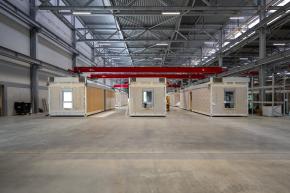
The Living Lab is a full-scale laboratory where we test, validate, and optimize industrialized construction solutions from the ZETHAUS system in an operational context.
More than just an experimental space, it is an environment where we anticipate the future: where construction ceases to be a fragmented and unpredictable process and instead becomes grounded in an industrial logic, with greater control, efficiency, and quality. It is, in essence, a tool to accelerate the sector’s transformation.
“The Living Lab is a full-scale laboratory where we test, validate, and optimize industrialized construction solutions from the ZETHAUS system in an operational context.”
What are the key features of the ZETHAUS construction model, and how is it developed throughout the different phases of the project?
The model is based on the industrialization of construction, modularity, and process integration. We transfer a significant portion of production to the factory, ensuring greater quality control, reduced waste, and predictability.
One of the fundamental aspects of this model is the integrated management of all phases of the process, from design to production and assembly. It is precisely in the initial design phases that much of the system’s efficiency is determined.
Methodologies such as BIM (Building Information Modeling) and DfMA (Design for Manufacturing and Assembly) are therefore crucial, allowing for precise design, the anticipation of constraints, the optimization of solutions, and the alignment of the design with industrial logic from the very beginning.
The ZETHAUS construction system allows for the design and construction of buildings based on two major complementary dimensions: three-dimensional (3D) and two-dimensional (2D), which can operate independently or in combination.
Thus, it is developed using fully factory-produced and finished three-dimensional modules, two-dimensional components organized into “kits of parts,” and the integration of both (3D + 2D), which allows for a response to different programmatic requirements and contexts while ensuring both production efficiency and architectural flexibility.
At the Living Lab, these principles are applied progressively and across different functional typologies, allowing solutions to be tested in a real-world context.
What types of functional programs are being tested, and how is adaptation to different contexts ensured?
We are developing solutions for collective housing, student housing, senior housing, hospitality, and service buildings. This diversity allows us to test the system under different functional and operational requirements.
The hybrid system and modular logic allow for a high degree of adaptability, whether in dense urban contexts or in less densely populated areas.
The goal is precisely to demonstrate that industrialization does not imply rigidity; on the contrary, it can be a tool for flexibly responding to different social and territorial realities.
When you speak of a “new way of building” or a “new grammar,” what specifically changes compared to the traditional model?
The change is structural. We’ve moved from a site-based model, dependent on variables that are difficult to control, to an industrial model, where production is planned, repeatable, and optimized.
If we draw an analogy with the automotive industry, it would be unthinkable to produce the same car differently in each factory. In construction, this still happens. Industrialization is precisely what introduces consistency, predictability, and continuous improvement.
This translates into less waste, higher quality, greater safety, and, above all, the ability to scale up production—something essential to addressing the current pressure on housing.
Naturally, new ways of building also imply new ways of thinking and designing.
At ZETHAUS, we work with 2D and 3D modular building systems that function as a building alphabet. Using these components, we are able to create different solutions, architectural languages, and ways of living.
But that doesn’t mean sacrificing creativity or architectural identity. And this is where our collaboration with Norman Foster is so important. He brought a very clear vision that industrialization shouldn’t be merely a technical or industrial exercise. It must also improve the quality of architecture and people’s lives.
The R2U Agenda is deeply aligned with this vision of bringing together technology, sustainability, design, and social thinking.
Inspired by the principles of the New European Bauhaus, our agenda proposes a digital, modular construction model with a strong export focus, and Norman Foster’s contribution has helped us precisely to consolidate this ambition: to show that it is possible to build more efficiently, more sustainably, and at the same time in a more humane way.
Ultimately, this new grammar is exactly that: a new way of constructing buildings and cities, better prepared for the challenges of the future.
How can industrialized construction contribute to sustainability and access to housing?
Industrialized construction allows for much more rigorous management of materials, reducing waste and optimizing resources.
Factory production entails lower energy consumption, greater environmental control, and better building performance throughout their lifecycle.
At the same time, it increases process efficiency and significantly reduces construction timelines—by 20% to 60%—compared to traditional methods. This creates the conditions for a faster and more predictable response to housing demand.
In a context where the housing shortage is significant, only models capable of producing at scale, with quality and cost control, can provide an effective solution.
By transferring a large part of the process to the factory, we are able to reduce waste, ensure higher quality of execution, and significantly accelerate construction, without compromising flexibility or architectural quality.
“In the case of ZETHAUS, what we seek is precisely to combine technology, sustainability, and architecture, creating solutions that are not only more efficient but also more humane and dignified for those who will inhabit these spaces.”
More than just building faster, we’re talking about building better and structurally transforming the way we think about construction and cities.
“The R2U Agenda is closely aligned with this vision of bringing together technology, sustainability, design, and social thinking.”
What role do training and qualifications play in the new construction model, and how does the professional and advanced training at Escola dst fit into this new paradigm?
The transformation of the sector also requires a transformation of skills.
Industrialization creates new roles and demands more qualified professionals with technical, digital, and industrial skills.
Escola dst plays a central role here, ensuring the preparation of specialized personnel for industrialized construction by developing training programs aligned with this new paradigm.
The goal is to prepare professionals for a more technological, safe, and collaborative production environment, making the sector more attractive to new generations.
What is the potential for expansion of this model, and to what extent might it evolve?
The potential is very significant.
Industrialization is not a trend; it is an inevitable evolution of the sector, driven by the need for efficiency, sustainability, and scale.
As the legislative framework adapts, processes become established, and the market gains confidence, this model will tend to expand.
Its ability to adapt to different uses and geographies makes it particularly relevant in a European context, where the challenges of housing and the energy transition are cross-cutting.
There is also a less visible but profoundly transformative dimension: the improvement of working conditions.
By transferring much of the activity to a factory environment, we create safer, more stable, and technologically more advanced contexts.
This allows us not only to enhance the value of the work but also to attract new professional profiles and promote greater diversity in the sector.
In particular, this transformation has had a direct impact on attracting talent and integrating women into technical and production roles by creating conditions more compatible with modern, inclusive, and skilled industrial environments.
This is a structural change that is not only technical but also social, contributing to a more inclusive, skilled, and future-ready construction sector.