- Engineering & Construction
- Environment
- Telecommunications
- Renewable energies
- Ventures
- Real estate
Respect. (from the lat. respectu) n. 1. respect; 2. consideration; high regard; 3. deference; compliance; veneration; 4. honour; worship; 5. relation; refererence...
We believe that everyone should be respected for their work, for their attitudes, opinions and options.
Rigor. (from the lat. rigore) n. 1. harshness; strength; 2.fig., severity; punctuality; accuracy.
There is no "more or less levelled", "more or less upright”, "more or less clean" or "more or less safe", but rather “levelled”, "upright”, "clean” and “safe". The rigour is reflected in our procedures, in time and in the rules to follow. In the light of moral and principles, being severe means being rigorous.
Passion. (from the lat. passione) n. 1. intense and usually violent feeling (affection, joy, hate, etc.) which hinders the exercise of impartial logic; 2. derived from a feeling; 3. great predilection; 4. partiality; 5. great grief; immense suffering...
Under the sign of passion – a text of the Portuguese poet Regina Guimarães – is our icon. Passion is to reveal great enthusiasm for something, favourable encouragement or opposite to something.
It is the sensibility transmitted by an architect or engineer through work.
Passion is the dedication to a project. Passion is a state of warm soul.
Loyalty. (from the lat. legalitate) n. the quality of being loyal; fidelity; sincerity.
Respect for the principles and rules that guide the honour and probity. Faithfulness to commitments and agreements undertaken, staunch character.
To remain loyal to the business partners because we depend on them and they depend on us.
Being trustworthy for being loyal.
Solidarity. (from the lat. solidare) n. 1. the quality of being solidary; 2. reciprocal responsibility among the members of a group, namely social, professional, etc.; 3. sense of sharing another’s suffering.
Being solidary is being a friend, offering our hand with genuine generosity and bringing joy and human warmth to those who, somehow, are marginalized. Being solidary is being more human. A solidary company is recognized as a fair and non-selfish company. A solidary company is a preferred choice in business. It is a more competitive company. Volunteering is a vehicle to solidarity. It is modern, fair, cultured, friend, it is a noble gesture of moral elevation.
Courage. (from the lat. coraticum) n. 1. bravery facing danger; intrepidity; to have audacity; 2. moral force before a suffering or setback; 3. [fig.] to input energy when performing a difficult task; perseverance...
Courage is essential in our life. Courage to face less pleasant situations when complex issues come up, not expecting random resolutions.
It is a value that we must highlight as opposed to the fearful, cowardly and laziness.
The courage to react to criticism not with an attitude of demotivation or sadness, but rather to search for the means and the action to overcome its own reason. This kind of courage, which is also an intellectual courage, is highly recommended.
Ambition. (from the lat. ambitione) n. 1. vehement desire of wealth, honours or glories; 2. expectation about the future; aspiration; 3. lust; greed…
Vehement desire to achieve a particular goal. Ambition not to resign ourselves. Ambition to take the best potential from ourselves. Ambition to deserve ourselves. Ambition to be athletes in our top-level competitive jobs. Ambition to beat our brands. Ambition to get the best deals with the maximum value, due to the high levels of proficiency and efficiency.
Esthetics. ESTHETICS (from the Greek aisthetiké, "sensitive") n.f. 1. Philosophy branch of philosophy that studies the beauty and nature of artistic phenomena; 2. author's own style, time, etc.; 3. harmony of shapes and colors, beauty; 4. set of techniques and treatments that aim to beautify the body.
We decided to build the company's economic foundations under a cultured, cosmopolitan and cool image. Because it is a charming state of being. Good taste because we are sustainable and we respect the planet. Good taste because we are sensitive. Good taste just because.
Responsibility. (from the lat respondere) n. the trait of being answerable to someone for something or being responsible for one's conduct; a form of trustworthiness.
We must be certain that, before a choice, we chose what is best for both of us and not just the best for each one. Each employee is responsible for his negotiated activity and co-responsible if the co-worker does not fulfil his own task, thus preventing the common goal. A team is a set of individuals - is a whole. In the business game, as in social or family contexts, everyone must comply with their own relative position and we shall not permit that one of ours fails to be in our team.
ECO
b.again, part of dstgroup, is the first company to recycle lithium cells and batteries in Portugal. It has installed processing capacity of up to 7,000 tonnes and is already looking towards industrial-scale production.
At a time when sales of electric vehicles are increasing and more electrified cars are circulating on the roads, Portugal has had a lithium cell and battery recycling plant since March, the first in the Iberian Union. Owned by dstgroup, b.again has the capacity to process up to 7,000 tonnes a year. The aim is to use these spent batteries to obtain black mass containing critical materials, which can then be extracted for use in new batteries. For now, that extraction will have to take place abroad, but in Braga the next step is already being considered: extracting these materials in Portugal too.
As part of the NGS – New Generation Storage mobilising agenda under the Recovery and Resilience Plan (PRR), led by Braga-based dst, b.again wants to give end-of-life batteries a second life when they arrive at dst’s industrial park in Palmeira. In a process that is anything but simple — and may even cause the occasional fire, for which the factory is already prepared — the batteries received are first discharged, then sorted, dismantled and shredded to obtain black mass, from which critical raw materials such as lithium, graphite, cobalt and nickel will subsequently be extracted.
“It is a very complex process because the batteries need to be sorted, we need to understand their safety condition, and then they need to be discharged. These are time-consuming processes involving hazardous material and are therefore quite complex,” explains Filipe Silva, commercial director of b.again.
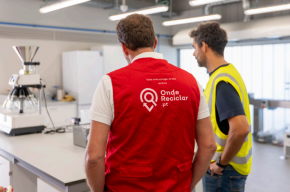
“Basically, it is about making use of batteries we no longer need but which still contain critical raw materials that will be useful in the future, to manufacture new batteries or other advanced materials. Recovering those raw materials from batteries we no longer use and giving them value again,” emphasises b.again’s managing director, João Gomes, during a visit to the factory as part of Electrão Open Day.
The dry mechanical shredding process, carried out at low temperature and pressure in an inert atmosphere, achieves a material recovery rate of over 95%.
“The batteries we already have are also mines from which we can recover these critical raw materials and avoid relying so heavily on virgin raw materials,” he explains.
With around 500 tonnes of material already processed since operations began in March, the Braga-based company is now accelerating its processes. The first cross-border exports are expected by the end of the year. As Portugal does not yet have a lithium refinery, the final stage of processing these materials cannot take place in the country.
“After obtaining the black mass, we have the extraction stage for these materials — the critical raw materials we have been discussing. In our case, we do not yet have this process on an industrial scale, but we are already developing it at laboratory level,” says Rui Sousa, production director at b.again. “The next step could also be to invest in hydrometallurgical capacity in Portugal so that these materials can also be extracted domestically,” he adds.
More batteries to recycle
But accelerating production requires more raw material. “We need greater critical mass to make this investment, but we are already investing in innovation, process control and the development of the process itself — in our case, hydrometallurgical solvent extraction,” says the same official.
Until the company can take this next step, the black mass will be sent abroad for the metals to be extracted. “At present, Portugal simply does not have that capacity. So we are talking about exporting a hazardous material,” he concludes.
With an eye on the neighbouring market, b.again wants to expand into Spain. “That is also part of the aim: to obtain the volume of batteries we need, not only to optimise the processes and essentially bring them to full capacity, but also to look towards the next stage,” Rui Sousa acknowledges.
“b.again is a benchmark for us, in that it is the first lithium battery recycling facility we have, it is the only one on the Iberian Peninsula, and we are clearly very pleased to have a local partner that guarantees proper recycling of the batteries we collect.”
Ricardo Furtado
General Director for Electrical Equipment and Batteries at Electrão
Ricardo Furtado, General Director for Electrical Equipment and Batteries at Electrão, points out that “b.again is a benchmark for us, in that it is the first lithium battery recycling facility we have, and it is the only one on the Iberian Peninsula”. “We are very pleased to have a local partner that guarantees proper recycling of the batteries we collect,” he stresses.
“We were used to having to export the batteries collected in the country to foreign recyclers, so it is always good to have installed capacity here that essentially provides an outlet with a better environmental footprint, because transporting them over long distances obviously creates more emissions. It also allows us to have a close relationship that we did not have with recyclers abroad,” he concludes.