- Engineering & Construction
- Environment
- Telecommunications
- Renewable energies
- Ventures
- Real estate
Respect. (from the lat. respectu) n. 1. respect; 2. consideration; high regard; 3. deference; compliance; veneration; 4. honour; worship; 5. relation; refererence...
We believe that everyone should be respected for their work, for their attitudes, opinions and options.
Rigor. (from the lat. rigore) n. 1. harshness; strength; 2.fig., severity; punctuality; accuracy.
There is no "more or less levelled", "more or less upright”, "more or less clean" or "more or less safe", but rather “levelled”, "upright”, "clean” and “safe". The rigour is reflected in our procedures, in time and in the rules to follow. In the light of moral and principles, being severe means being rigorous.
Passion. (from the lat. passione) n. 1. intense and usually violent feeling (affection, joy, hate, etc.) which hinders the exercise of impartial logic; 2. derived from a feeling; 3. great predilection; 4. partiality; 5. great grief; immense suffering...
Under the sign of passion – a text of the Portuguese poet Regina Guimarães – is our icon. Passion is to reveal great enthusiasm for something, favourable encouragement or opposite to something.
It is the sensibility transmitted by an architect or engineer through work.
Passion is the dedication to a project. Passion is a state of warm soul.
Loyalty. (from the lat. legalitate) n. the quality of being loyal; fidelity; sincerity.
Respect for the principles and rules that guide the honour and probity. Faithfulness to commitments and agreements undertaken, staunch character.
To remain loyal to the business partners because we depend on them and they depend on us.
Being trustworthy for being loyal.
Solidarity. (from the lat. solidare) n. 1. the quality of being solidary; 2. reciprocal responsibility among the members of a group, namely social, professional, etc.; 3. sense of sharing another’s suffering.
Being solidary is being a friend, offering our hand with genuine generosity and bringing joy and human warmth to those who, somehow, are marginalized. Being solidary is being more human. A solidary company is recognized as a fair and non-selfish company. A solidary company is a preferred choice in business. It is a more competitive company. Volunteering is a vehicle to solidarity. It is modern, fair, cultured, friend, it is a noble gesture of moral elevation.
Courage. (from the lat. coraticum) n. 1. bravery facing danger; intrepidity; to have audacity; 2. moral force before a suffering or setback; 3. [fig.] to input energy when performing a difficult task; perseverance...
Courage is essential in our life. Courage to face less pleasant situations when complex issues come up, not expecting random resolutions.
It is a value that we must highlight as opposed to the fearful, cowardly and laziness.
The courage to react to criticism not with an attitude of demotivation or sadness, but rather to search for the means and the action to overcome its own reason. This kind of courage, which is also an intellectual courage, is highly recommended.
Ambition. (from the lat. ambitione) n. 1. vehement desire of wealth, honours or glories; 2. expectation about the future; aspiration; 3. lust; greed…
Vehement desire to achieve a particular goal. Ambition not to resign ourselves. Ambition to take the best potential from ourselves. Ambition to deserve ourselves. Ambition to be athletes in our top-level competitive jobs. Ambition to beat our brands. Ambition to get the best deals with the maximum value, due to the high levels of proficiency and efficiency.
Esthetics. ESTHETICS (from the Greek aisthetiké, "sensitive") n.f. 1. Philosophy branch of philosophy that studies the beauty and nature of artistic phenomena; 2. author's own style, time, etc.; 3. harmony of shapes and colors, beauty; 4. set of techniques and treatments that aim to beautify the body.
We decided to build the company's economic foundations under a cultured, cosmopolitan and cool image. Because it is a charming state of being. Good taste because we are sustainable and we respect the planet. Good taste because we are sensitive. Good taste just because.
Responsibility. (from the lat respondere) n. the trait of being answerable to someone for something or being responsible for one's conduct; a form of trustworthiness.
We must be certain that, before a choice, we chose what is best for both of us and not just the best for each one. Each employee is responsible for his negotiated activity and co-responsible if the co-worker does not fulfil his own task, thus preventing the common goal. A team is a set of individuals - is a whole. In the business game, as in social or family contexts, everyone must comply with their own relative position and we shall not permit that one of ours fails to be in our team.
Correio do Minho
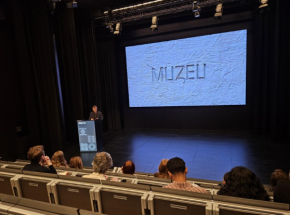
As part of the public opening of MUZEU, the dst Museum of Thought and Contemporary Art, a delegation of national and international journalists yesterday visited the new cultural venue, while also touring the dst campus and the zet gallery.
With its official opening scheduled for Freedom Day (25 April), MUZEU, the dst Museum of Thought and Contemporary Art is already shaping the life of the city through a series of initiatives designed to present this new space dedicated to contemporary art, philosophy and public debate in Braga, drawing on the collections of the dst group and José Teixeira.
Following the inauguration of Julian Opie’s work ‘Saturday Night Couple 2’ outside the building, yesterday the museum’s opening provided the occasion for a special programme for journalists, who also visited the dst campus and zet gallery.
The delegation was welcomed by José Teixeira, CEO of the group, who emphasised that “Work, as a factor of production, must be supported (to ensure competitiveness and natural, biological and environmental homeostasis) through education, training and knowledge - culture as Archimedean levers. Support is culture.”
“Cultural education is an ongoing process with no fixed endpoint. It is not solely the responsibility of governments or cities, but also a role of the economy”, argues José Teixeira, noting that “Architecture and art, along with the humanities and philosophy, play fundamental roles in the services and products companies create and deliver. For the world to be fairer, for everyone to have a good life, we must, within companies, take part in this beginning and enter this starting point.”
“The MUZEU is the place we have chosen to share with others what does us good. MUZEU is a metaphysical space. It is not merely social responsibility, but a social duty”, argues the CEO of the dst group. After the welcome session, Teixeira explained how the project came about, a project that has left a mark not only on the company, but also on the city, the region and even the country. The aim, he noted, is for MUZEU to have a “Bilbao effect”, that is, “using culture to help make the world a more beautiful place for more people”.
“During Ricardo Rio’s first mayoral campaign, he set up a group to define Braga’s strategy. I was part of that group and responsible for culture. I used to say that in a cosmopolitan city programme, there can be no city without a museum and a school of arts. The museum is now done; what’s still missing is the art school”, he indicated.
Teixeira admitted that he “did not expect it to be a private initiative that would build the museum”, but that is what happened, following what he describes as an epiphany.
“We had this space that was almost licensed for a hotel. Then came the epiphany: what if it were a museum? And why a museum? It could have been something else. We could have placed the MUZEU’s budget into a foundation, or into the ongoing costs of running MUZEU, where 16 people work, or into a programme in Africa, such as a literacy or a hunger relief programme. Indeed, it could have been anything.” He explained that such alternatives reflect a utilitarian mindset, those who argue that “there is always something more important to do.” However, “from that perspective”, he maintains, “there would be no opera, no literature, no poetry, no art, and without those, there is nothing, there is no life. Without art, there is no life. That is why we chose art. Art is a tool, poetry is a tool, literature is a tool, just as dance is a tool. They are instruments that, in reality, provide an escape from poverty and misery.”