- Engineering & Construction
- Environment
- Telecommunications
- Renewable energies
- Ventures
- Real estate
Respect. (from the lat. respectu) n. 1. respect; 2. consideration; high regard; 3. deference; compliance; veneration; 4. honour; worship; 5. relation; refererence...
We believe that everyone should be respected for their work, for their attitudes, opinions and options.
Rigor. (from the lat. rigore) n. 1. harshness; strength; 2.fig., severity; punctuality; accuracy.
There is no "more or less levelled", "more or less upright”, "more or less clean" or "more or less safe", but rather “levelled”, "upright”, "clean” and “safe". The rigour is reflected in our procedures, in time and in the rules to follow. In the light of moral and principles, being severe means being rigorous.
Passion. (from the lat. passione) n. 1. intense and usually violent feeling (affection, joy, hate, etc.) which hinders the exercise of impartial logic; 2. derived from a feeling; 3. great predilection; 4. partiality; 5. great grief; immense suffering...
Under the sign of passion – a text of the Portuguese poet Regina Guimarães – is our icon. Passion is to reveal great enthusiasm for something, favourable encouragement or opposite to something.
It is the sensibility transmitted by an architect or engineer through work.
Passion is the dedication to a project. Passion is a state of warm soul.
Loyalty. (from the lat. legalitate) n. the quality of being loyal; fidelity; sincerity.
Respect for the principles and rules that guide the honour and probity. Faithfulness to commitments and agreements undertaken, staunch character.
To remain loyal to the business partners because we depend on them and they depend on us.
Being trustworthy for being loyal.
Solidarity. (from the lat. solidare) n. 1. the quality of being solidary; 2. reciprocal responsibility among the members of a group, namely social, professional, etc.; 3. sense of sharing another’s suffering.
Being solidary is being a friend, offering our hand with genuine generosity and bringing joy and human warmth to those who, somehow, are marginalized. Being solidary is being more human. A solidary company is recognized as a fair and non-selfish company. A solidary company is a preferred choice in business. It is a more competitive company. Volunteering is a vehicle to solidarity. It is modern, fair, cultured, friend, it is a noble gesture of moral elevation.
Courage. (from the lat. coraticum) n. 1. bravery facing danger; intrepidity; to have audacity; 2. moral force before a suffering or setback; 3. [fig.] to input energy when performing a difficult task; perseverance...
Courage is essential in our life. Courage to face less pleasant situations when complex issues come up, not expecting random resolutions.
It is a value that we must highlight as opposed to the fearful, cowardly and laziness.
The courage to react to criticism not with an attitude of demotivation or sadness, but rather to search for the means and the action to overcome its own reason. This kind of courage, which is also an intellectual courage, is highly recommended.
Ambition. (from the lat. ambitione) n. 1. vehement desire of wealth, honours or glories; 2. expectation about the future; aspiration; 3. lust; greed…
Vehement desire to achieve a particular goal. Ambition not to resign ourselves. Ambition to take the best potential from ourselves. Ambition to deserve ourselves. Ambition to be athletes in our top-level competitive jobs. Ambition to beat our brands. Ambition to get the best deals with the maximum value, due to the high levels of proficiency and efficiency.
Esthetics. ESTHETICS (from the Greek aisthetiké, "sensitive") n.f. 1. Philosophy branch of philosophy that studies the beauty and nature of artistic phenomena; 2. author's own style, time, etc.; 3. harmony of shapes and colors, beauty; 4. set of techniques and treatments that aim to beautify the body.
We decided to build the company's economic foundations under a cultured, cosmopolitan and cool image. Because it is a charming state of being. Good taste because we are sustainable and we respect the planet. Good taste because we are sensitive. Good taste just because.
Responsibility. (from the lat respondere) n. the trait of being answerable to someone for something or being responsible for one's conduct; a form of trustworthiness.
We must be certain that, before a choice, we chose what is best for both of us and not just the best for each one. Each employee is responsible for his negotiated activity and co-responsible if the co-worker does not fulfil his own task, thus preventing the common goal. A team is a set of individuals - is a whole. In the business game, as in social or family contexts, everyone must comply with their own relative position and we shall not permit that one of ours fails to be in our team.
Negócios
José Teixeira places people at the centre of the group’s strategy and links innovation to a culture of greater employee autonomy.
“Ethos, its nature, its character and its soul are the source of all possibilities, and it is the values associated with these moral and ethical principles that make us a business community of workers,” says José Teixeira, chairman of dst Group. Those values include taking pride in doing things well, practical know-how, and the importance attached to ethics and responsibility.
According to the chairman of dst Group, this corporate culture is rooted in the legacy of its founder, Domingos da Silva Teixeira, who started the business in Braga in the 1940s by extracting stone for the construction of the 1.º de Maio Stadium. Since 2010, dst Group has been led by José Teixeira, the founder’s son and a civil engineer, who took over the chairmanship following his father’s death and shares management with his brothers Hernâni, Joaquim and Avelino. He also reveals that “the next generation is already in the group, in positions of the highest responsibility”.
Business democracy
The shortage of skilled workers, particularly in construction and engineering, is one of the biggest challenges to growth. dst’s response involves a training policy covering different qualification levels. The group offers higher professional technical courses (CTeSP), master’s degrees and doctorates, and has established the dst Industrial School for secondary-school students.
“It is in times of stress and scarcity that knowledge and business democracy prove to be the nourishment of sustainable growth,” says José Teixeira. “We provide training throughout the entire labour value chain,” he adds. The company also seeks to change the sector’s traditional profile, particularly by bringing more women into roles previously held predominantly by men. Employee participation is another dimension of this corporate culture. José Teixeira advocates an organisation that does not simply demand obedience, saying that participation has brought “greater understanding, greater cooperation and comprehension”. Some employees are already shareholders in the company, and the intention is to continue developing this approach. In addition, the company pays more than its competitors and “we hold many more parties. In our group of companies, we spend a lot of time being cicadas”.
Culture and innovation
Culture, in turn, is presented as an instrument of innovation. At dst, there is training in philosophy, rhetoric and art history, as well as reading during working hours. For the group’s chairman, these elements have a tangible impact on the organisation’s creative capacity. “It is measured by the number of ideas that appear in our innovation box, by our turnover, our EBITDA, the diversity of our businesses, and the complexity and originality of those businesses. With physics, mathematics and chemistry alone, we could not have workers who are so free, emancipated and creative,” José Teixeira said.
dst has a venture capital arm directly linked to the group’s innovation model, which supports start-ups, invests in patents and seeks to transform internal knowledge into new businesses. “There is a committee to assess projects, and that committee also decides on the spin-offs we have created from the ‘wisdom of crowds’ within our companies,” explains José Teixeira. It is at this intersection of business, people, knowledge and culture that José Teixeira also places MUZEU, a €40 million investment inaugurated in 2026.
https://pt.cision.com/cp/ClippingDetails.aspx?id=63aa1f27-3ee7-4261-90a7-48f1c806f0c1&analises=1&userid=0875f30e-b7fa-4e4b-8815-d65fd26ef7b0
dst Group: The construction company will become the leader in Portugal
The group, which has already exceeded €660 million in non-consolidated turnover, is becoming increasingly less dependent on construction while strengthening its position in areas such as industry, energy, the environment, railways, telecommunications and the circular economy.
dst Group ended 2025 with the best performance in its history in terms of growth, turnover and EBITDA, and anticipates a new business record in 2026. José Teixeira, 66, the group’s chairman, acknowledges that the challenges are numerous, beginning with the need to continue democratising the innovation process, identifying opportunities that are not yet visible and creating more sustainable services and products with greater economic value. He stresses that this process must also translate into more jobs, better wages and benefits.
Construction remains a core activity of dst Group, but now accounts for less than half of its business. In 2025, the group won the Special Jury Prize at the Export & Internationalisation Awards, organised by Novo Banco and Negócios in partnership with Iberinform. “We have room, in the construction industry business in Portugal, and with the DST construction company alone, probably to become this year the company operating in the Portuguese market with the highest turnover in the sector and to take the lead in Portugal. If we maintain a balance in the other areas alongside such substantial growth, it is a challenge we feel comfortable with,” José Teixeira said.
The group’s chairman explains that the logic behind diversification “is not greed for capital”. “We always look for businesses with an industrial component. We are interested in businesses where management know-how goes hand in hand with practical expertise. With this as our starting point, there can never be too much diversification,” says José Teixeira.
Strategy and diversification
He invokes the biblical parable of the talents: “We receive a number of talents from others among us, and we must multiply them for others among us and improve the lives of those who work and those who will come to work with us.” Nevertheless, he believes the greatest risk is “entering the wrong area. We have hesitated over the security sector. We cannot allow ourselves to make disproportionate mistakes. There is a piece of advice from our parents that we follow rigorously: never invest what you cannot afford to lose.”
This strategy has already taken DST into renewable energy, the environment, telecommunications, real estate, venture capital, batteries, industrialised construction and railways. The latter is a strategic area built around a railway hub in Pampilhosa for its own trains and for providing railway vehicle maintenance services. “We also want to win the third high-speed rail tender and two-thirds of high-speed rail in Portugal,” in which it is part of the consortium led by Sacyr. It has also won, in consortium with Alstom, the contract for 117 new CP trains.
The transformation of construction also involves industrialisation. DST is building factories and developing modular and industrialised solutions through Zethaus and Lyrical. “We are an industrial company and we are involved in production throughout the entire construction value chain. We will continue this commitment and open new factories every year,” José Teixeira assures.
Circular economy
In housing, industrialisation could speed up processes and reduce costs, but also change the very nature of the product, accelerate construction and make it more sustainable. “The house will be manufactured and sold as a product. Its soul belongs to the customers, and they are the ones who will bring it into the house.” The group is also developing solutions for collaborative housing, students, senior citizens and workers living away from home, already tested in Switzerland and Germany, offering homes “with lower, affordable rents”.
The circular economy is another area of growth because, for José Teixeira, “environmental rules are not a barrier” but an opportunity and a duty to respect our common home, and they can generate economic value. DST is investing in battery recycling and raw material recovery in partnership with China’s CALB, which is building a battery gigafactory in Sines, as part of a strategy that José Teixeira directly associates with value creation.
“Recycling and the circular economy are worth a great deal of money in our daily operations. We incorporate a great deal of waste that we process in our industry. Many materials have completed one life and begin another in a different role. That has social, moral and economic value,” says José Teixeira.
International expansion completes this transformation. DST already generates more than €100 million outside Portugal and continues to seek European markets, particularly Luxembourg, Switzerland and Germany. “We will continue to look to Europe to grow where we already operate and open new markets.”
“We incorporate a great deal of waste that we process in our industry. Many materials have completed one life and begin another in a different role. That has social, moral and economic value.”
JOSÉ TEIXEIRA
Chairman of DST Group
INDICATORS
Number of employees (2025): 3,000
Turnover (2025): over €660 million
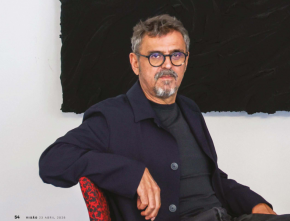
José Teixeira, chairman of DST Group.